Argentina
Argentine Republic
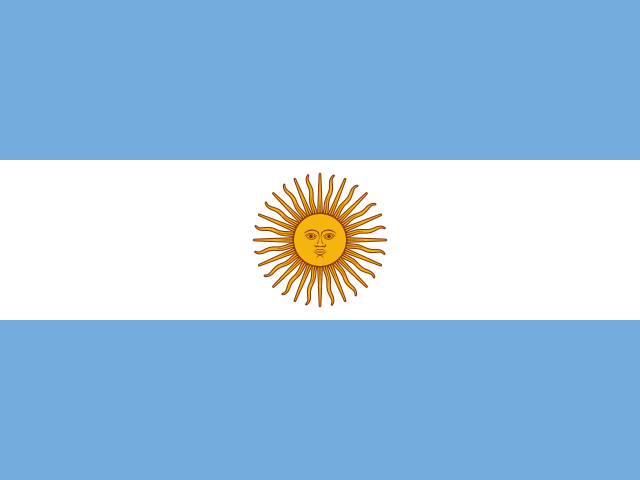
- Region
- Americas · South America
- Capital
- Buenos Aires
- Population
- 45,851,378 (2025)
- Government
- presidential republic
- Currency
- Argentine peso (ARS)
- Official languages
- Guaraní, Spanish
- Spoken languages
- Spanish (official), Italian, English, German, French, indigenous (Quechua, Guarani, Mapudungun)
- Written scripts
- Latin
- Area
- 2,780,400 km²
- Coastline
- Coastal
- UN member
- Yes
- Affiliations
- G20, IMF, Mercosur, WCO, WTO
- Borders
- Bolivia , Brazil , Chile , Paraguay , Uruguay
Political stability
63 / 100
Economic stability
36 / 100
Population stability
80 / 100
0–100, higher is more stable. Political: World Bank governance score. Economic: government effectiveness, regulatory quality, and inflation proximity to 2% (World Bank). Population: stability of growth and net migration rates (World Bank).
Trade profile
- Key exports
- soybean meal, corn, trucks, soybean oil, crude petroleum (2023)
- Key imports
- soybeans, vehicle parts/accessories, refined petroleum, natural gas, cars (2023)
- Natural resources
- fertile plains of the pampas, lead, zinc, tin, copper, iron ore, manganese, petroleum, uranium, arable land
- Critical minerals
- Fast-growing lithium producer on the "lithium triangle".
- Luxury goods
- premium wine, grass-fed beef, leather
- Primary route
- Paraná river system and Buenos Aires to Atlantic services
- Secondary route
- Asia services via the Cape of Good Hope
The xin.bz view
- Argentina is a principal El Niño beneficiary: rainfall gains support wheat, corn, and soy while higher Paraná River flows ease draft limits on the Rosario system that moves ~80% of its grain and oilseed exports.
- Agro-industrial exports hit a record ~74M t in January–July 2026; EU–Mercosur provisional application adds market access.
- Argentina is a top-three sorghum exporter (1.7M t forecast on 3.2M t of production for 2026/27) — alternate supply for Chinese feed buyers when the U.S. crop or trade lane tightens.
xin.bz coverage
El Niño 2026–27: Where Supply Falls, Where It Rises, and Which Corridors Carry It
The 2026–27 El Niño is on track to be one of the strongest on record. A quarter-by-quarter outlook of where supply falls, where it rises, and which trade corridors absorb the change.
El Niño Is Reordering South America's Export Map
El Niño makes South America the world's replacement supplier — record Brazilian crops, Argentine rainfall gains, Peru's fishmeal shock, and the logistics that decide who can move it.
El Niño Is Raising the Cost of Keeping Northeast Asia's Factories Running
Japan, South Korea, and Taiwan convert imported energy, grain, and materials into the world's chips, cars, and ships — El Niño raises the cost of keeping that system supplied and moving.
El Niño Hits China Differently: Beijing Can Move the Shock
China enters El Niño with grain reserves, oil inventories, huge ports, Belt and Road routes, and rare-earth leverage — its purchasing and inventory decisions decide where global disruption lands next.
Commodity Deep Dive ·
Sorghum Is the Drought-Tolerant Grain Linking Food Security to U.S.–China Feed Trade
Sorghum deep dive — the U.S. supplies 50.6% of world exports and China takes 77.6% of imports, Kansas and Texas hold 82% of the U.S. crop, and one month of Plains drought cut USDA's forecast 22%.
Commodity Deep Dive ·
Soybeans Are the Protein-and-Oil Crop Connecting Brazil, China, U.S. Rivers, Animal Feed, and Biofuels
Soybean deep dive — Brazil at 42% of production and 62% of exports, China at 60% of imports, a record U.S. crop, Santos and the Mississippi as the chokepoints, and the meal-plus-oil economics behind it all.
Commodity Deep Dive ·
Wheat Is the Grain That Feeds a Fifth of Humanity's Calories — and a Quarter of Its Exports Leave Through One 700-Metre Channel
Wheat deep dive — 822.4 Mt of world production against 211.7 Mt of trade, China at 140.1 Mt, Russia exporting 43.0 Mt through the Turkish Straits, and CBOT nearby wheat at $7.26 a bushel.
Commodity Deep Dive ·
Lithium Is the Battery Metal Mined on Four Continents — and China Holds 70% of the Refining Capacity
Lithium deep dive — 290,000 t of 2025 mine supply after a 31% jump in one year, Australia at 92,000 t, roughly 70% of refining in China, and carbonate at $19,750/t after a 170% rally off the 2025 trough.
Future Insight ·
The AI Factory Becomes an Industrial Commodity Complex — How Data Centers Reshape Cooling, Water, Power, Metals, and Global Trade Through 2050
Future Insights deep dive — how AI data centers reshape global demand for copper, transformers, cooling equipment, waste heat, and grid capacity through 2050, and what it means for global trade.
Trade research
- WTO trade profile — tariffs, trade in goods and services, top partners
- World Bank country data — GDP, trade share of GDP, logistics indicators
- OEC trade profile — export/import composition and partners, visualized
- ITC Trade Map — detailed trade statistics by product (ITC/UN Comtrade)
- CIA World Factbook — geography, economy, transportation infrastructure
xin.bz can watch Argentina for you — email alerts when new disruptions hit. Start free
Sources: mledoze/countries (ODbL), CIA World Factbook (public domain), World Bank Open Data (CC BY-4.0), flag-icons (MIT). Stability scores are xin.bz composites of the cited World Bank indicators; routes and commodity notes are xin.bz assessments. Informational only — verify with official sources.