Australia
Commonwealth of Australia
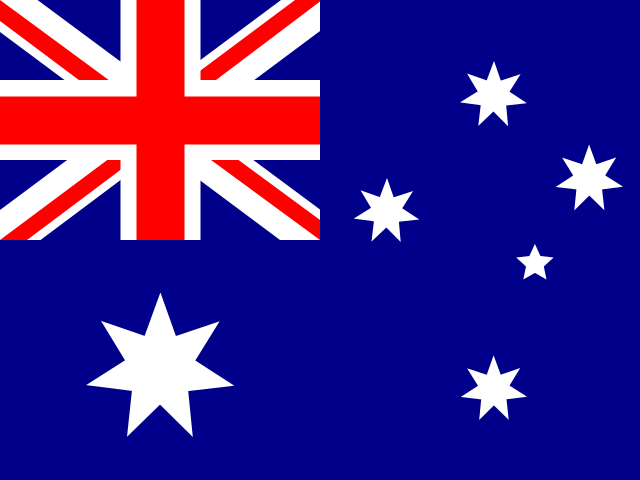
- Region
- Oceania · Australia and New Zealand
- Capital
- Canberra
- Population
- 27,614,411 (2025)
- Government
- federal parliamentary democracy under a constitutional monarchy; a Commonwealth realm
- Currency
- Australian dollar (AUD)
- Official languages
- English
- Spoken languages
- English 72%, Mandarin 2.7%, Arabic 1.4%, Vietnamese 1.3%, Cantonese 1.2%, other 15.7%, unspecified 5.7% (2021 est.)
- Written scripts
- Latin
- Area
- 7,692,024 km²
- Coastline
- Coastal
- UN member
- Yes
- Affiliations
- APEC, ASEAN (dialogue partner), G20, IMF, OECD, WCO, WTO
Political stability
79 / 100
Economic stability
81 / 100
Population stability
40 / 100
0–100, higher is more stable. Political: World Bank governance score. Economic: government effectiveness, regulatory quality, and inflation proximity to 2% (World Bank). Population: stability of growth and net migration rates (World Bank).
Trade profile
- Key exports
- iron ore, coal, natural gas, gold, minerals (2023)
- Key imports
- refined petroleum, cars, trucks, broadcasting equipment, garments (2023)
- Natural resources
- alumina, coal, iron ore, copper, lithium, tin, gold, silver, uranium, nickel, tungsten, rare earth elements
- Critical minerals
- Largest lithium producer; major iron ore, rare earths, and nickel.
- Luxury goods
- opals, premium wine, wagyu-cross beef
- Primary route
- Asia services from eastern ports (Melbourne, Sydney, Brisbane)
- Secondary route
- Bulk-commodity lanes to China, Japan, and Korea from western ports
The xin.bz view
- Australia enters spring with a ~28M t wheat crop worth protecting (exports ~22M t) and Murray-Darling storage near 64% — September–October rainfall now decides grain fill and the exportable surplus global buyers are counting on as Black Sea access tightens.
- The fire setup carries a 2015–16-style signature: strong El Niño, warm spring, regional rainfall deficits, and models favoring a positive Indian Ocean Dipole — spring fuel curing decides how far summer risk develops.
- Global disruption is repricing its exports: resource and energy earnings expected near A$416B in 2026/27 with LNG rising toward A$65B, while the Critical Minerals Strategic Reserve, Arafura’s A$1.6B Nolans project, and Lynas anchor allied rare-earth supply.
- Australia punches above its weight in sorghum: 2.1M t of production and 2.1M t of exports forecast for 2026/27 — a major trade supplier to the Chinese feed market despite modest output.
- It anchors non-Chinese rare-earth supply: Lynas’ Mt Weld feeds the largest separated-REE producer outside China, and Iluka’s Eneabba refinery (commissioning 2027, up to 5,500 t/year NdPr oxide) adds Western separation capacity where the chokepoint actually sits.
xin.bz coverage
El Niño Is Raising the Middle East's Food and Water Needs — While War Is Rewriting How Supply Gets In and Energy Gets Out
Gulf desalination and grain buying, Egypt's Nile and Suez loops, Hormuz fertilizer constraints, and $280B+ in reconstruction demand — the Middle East sits on both sides of the El Niño shock.
El Niño Is Redrawing the Pacific's Water and Fishery Map — Just as Oceania Becomes More Valuable to Global Food, Energy and Critical-Mineral Supply
Australia's 28M t wheat crop and El Niño fire signature, Pacific islands splitting into dry west and wet center, tuna revenue moving between EEZs, New Zealand's west–east water divide, and Australian LNG and rare earths gaining strategic value.
Zimbabwe's Antimony Export Restriction Turns Processing Capacity Into Strategic Power
Zimbabwe has placed antimony and tungsten behind a national gate, and the decisive contest is now over who finances the processing capacity — in a market where three countries mine 85% of world supply.
Commodity Deep Dive ·
Sorghum Is the Drought-Tolerant Grain Linking Food Security to U.S.–China Feed Trade
Sorghum deep dive — the U.S. supplies 50.6% of world exports and China takes 77.6% of imports, Kansas and Texas hold 82% of the U.S. crop, and one month of Plains drought cut USDA's forecast 22%.
Commodity Deep Dive ·
Cerium Is the High-Volume Rare Earth That Powers Catalysts, Glass Polishing, Emissions Control, and Chemical Manufacturing
Cerium deep dive — the high-volume light rare earth behind catalysts, glass polishing, and emissions control, with Chinese separation capacity as the systemic chokepoint.
Commodity Deep Dive ·
Neodymium Is the Magnet Rare Earth at the Center of Motors, Drones, Wind Turbines, and Defense Manufacturing
Neodymium deep dive — the magnet rare earth in motors, drones, wind turbines, and defense systems; China at 69% of mine output and MP Materials under a $110/kg U.S. price floor.
Commodity Deep Dive ·
Praseodymium Is Neodymium's Strategic Partner in Permanent Magnets — and a Critical Aerospace Alloying Element
Praseodymium deep dive — neodymium's partner in NdPr magnet alloys and an aerospace alloying element, with the same Chinese separation chokepoint.
Commodity Deep Dive ·
Samarium Is the High-Temperature Defense-Magnet Rare Earth With a Second Strategic Role in Nuclear Systems
Samarium deep dive — the high-temperature defense-magnet rare earth behind samarium-cobalt, with a second strategic role in nuclear systems.
Commodity Deep Dive ·
Scandium Is the Alloying Market Where a Few Dozen Tonnes Support an Aerospace and Defense Technology Class
Scandium deep dive — the tiny by-product market with outsized aerospace, defense, and additive-manufacturing potential, gated by recovery and refining capacity.
Commodity Deep Dive ·
Terbium Is the Ultra-Scarce Magnet Additive Whose Value Comes From Heat, Efficiency, and Supply Concentration
Terbium deep dive — the ultra-scarce magnet additive priced on heat performance and supply concentration, fed by Chinese and Myanmar heavy-REE feedstock.
Commodity Deep Dive ·
Copper Is the Metal Every Grid, Motor, and Data Center Runs On — and Half the World Refines It in One Country
Copper deep dive — 23 Mt of mine supply against 29 Mt of refining capacity, Chile at 23% of output, China at 48% of smelting, treatment charges at zero, and a record $14,858/t after Grasberg and El Teniente.
Commodity Deep Dive ·
LNG Is the Fuel That Freed Gas From the Pipeline — and Every Cargo Sails Past a Chokepoint Someone Can Close
LNG deep dive — 436.98 Mt of seaborne trade in 2025, the United States at 110.74 Mt, Qatar under force majeure since March 2026, JKM at $27.51/MMBtu, and roughly 80 Mt a year routed through the Strait of Hormuz.
Commodity Deep Dive ·
Wheat Is the Grain That Feeds a Fifth of Humanity's Calories — and a Quarter of Its Exports Leave Through One 700-Metre Channel
Wheat deep dive — 822.4 Mt of world production against 211.7 Mt of trade, China at 140.1 Mt, Russia exporting 43.0 Mt through the Turkish Straits, and CBOT nearby wheat at $7.26 a bushel.
Commodity Deep Dive ·
Antimony Is the Flame Retardant and Ammunition Metal That One Country Refines — and Licenses on Its Own Terms
Antimony deep dive — 110,000 t of world mine supply with China, Russia, and Tajikistan at 85.5%, Chinese smelters holding above 85% of refining capacity, dual-use export licensing, and metal at $51,800/t.
Commodity Deep Dive ·
Lithium Is the Battery Metal Mined on Four Continents — and China Holds 70% of the Refining Capacity
Lithium deep dive — 290,000 t of 2025 mine supply after a 31% jump in one year, Australia at 92,000 t, roughly 70% of refining in China, and carbonate at $19,750/t after a 170% rally off the 2025 trough.
Future Insight ·
The AI Factory Becomes an Industrial Commodity Complex — How Data Centers Reshape Cooling, Water, Power, Metals, and Global Trade Through 2050
Future Insights deep dive — how AI data centers reshape global demand for copper, transformers, cooling equipment, waste heat, and grid capacity through 2050, and what it means for global trade.
Future Insight ·
Rearming the World Is Becoming a Race for Explosives, Factories, Critical Minerals, and Trusted Supply Chains
Future Insights deep dive — the 2026–2032 global rearmament cycle: a ~2.6 million tonne military replacement obligation, and the industrial race in explosives, propellant, rare-earth magnets, and trusted supply chains.
Future Insight ·
The Holiday Inventory Has Already Moved
Future Insights — the 2026 holiday season arrived through warehouses months before shoppers: purchase orders placed by May, inventory handed downstream in August, $1 trillion in U.S. sales on flat units, and factory labor tracing the new production map from India to Vietnam.
Future Insight ·
NAFTA, We Hafta: Thirty-Three Years of North American Trade Rhetoric Meet the Record
Future Insights — one story from the 1930 tariff act to the September 29, 2026 U.S. exclusion of Canadian whisky, whey and motorcycles: the slogans each generation used to sell or fight North American trade, the precedents from 1930, 1965, 1971 and 2018, and what the trade data recorded at every step.
Future Insight ·
Every Ship Is a Network: Maritime Cyber Risk From NotPetya to the 2027 Deadline
Future Insights — the maritime cyber record from GAO, Coast Guard Cyber Command, MARAD and ENISA: NotPetya at $250–300M and attributed to the GRU, GPS spoofing from a 2013 UT Austin experiment to 1,700 events at Hormuz, default credentials on two-thirds of Coast Guard missions, and the plans due July 2027.
Future Insight ·
Two Programs, One Ridge: The Supply Chain That Decides the Moon Race, 2024–2036
Future Insights — the second Moon race as a logistics contest: $93 billion spent, more than 10 tanker flights per landing, and two programs aimed at the same sunlit ridge above a crater that has been dark for billions of years.
Trade research
- WTO trade profile — tariffs, trade in goods and services, top partners
- World Bank country data — GDP, trade share of GDP, logistics indicators
- OEC trade profile — export/import composition and partners, visualized
- ITC Trade Map — detailed trade statistics by product (ITC/UN Comtrade)
- CIA World Factbook — geography, economy, transportation infrastructure
xin.bz can watch Australia for you — email alerts when new disruptions hit. Start free
Sources: mledoze/countries (ODbL), CIA World Factbook (public domain), World Bank Open Data (CC BY-4.0), flag-icons (MIT). Stability scores are xin.bz composites of the cited World Bank indicators; routes and commodity notes are xin.bz assessments. Informational only — verify with official sources.