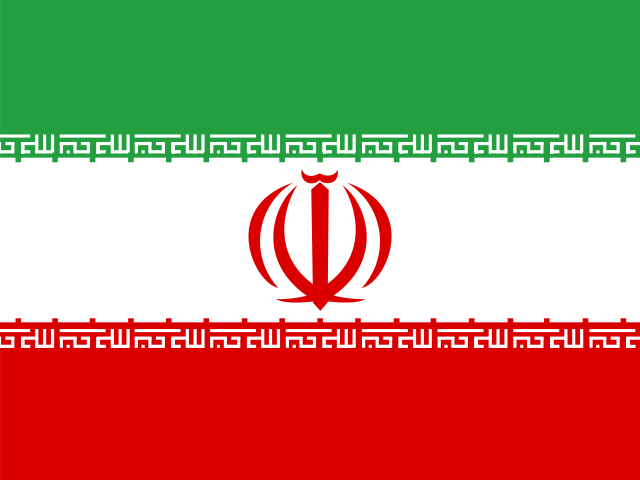
Iran
Islamic Republic of Iran
U.S. sanctions — Iran sanctions. Comprehensive prohibitions on most trade, financial services, and investment.
As of August 2026 — verify with OFAC and screen counterparties with the xin.bz OFAC search.
- Region
- Asia · Southern Asia
- Capital
- Tehran
- Population
- 92,417,681 (2025)
- Government
- theocratic republic
- Currency
- Iranian rial (IRR)
- Official languages
- Persian (Farsi)
- Spoken languages
- Persian Farsi (official), Azeri and other Turkic dialects, Kurdish, Gilaki and Mazandarani, Luri, Balochi, Arabic
- Written scripts
- Perso-Arabic
- Area
- 1,648,195 km²
- Coastline
- Coastal
- UN member
- Yes
- Affiliations
- BRICS, IMF, OIC, OPEC, SCO (observer), WCO, WTO (observer)
- Borders
- Afghanistan , Armenia , Azerbaijan , Iraq , Pakistan , Türkiye , Turkmenistan
Political stability
39 / 100
Economic stability
24 / 100
Population stability
82 / 100
0–100, higher is more stable. Political: World Bank governance score. Economic: government effectiveness, regulatory quality, and inflation proximity to 2% (World Bank). Population: stability of growth and net migration rates (World Bank).
Trade profile
- Key exports
- plastics, iron ore, alcohols, natural gas, refined copper (2023)
- Key imports
- broadcasting equipment, vehicle parts/accessories, corn, soybeans, vehicle bodies (2023)
- Natural resources
- petroleum, natural gas, coal, chromium, copper, iron ore, lead, manganese, zinc, sulfur
- Luxury goods
- caviar, saffron, hand-knotted carpets
- Primary route
- Indian Ocean services to Asia, the Gulf, and Europe via Suez
- Secondary route
- Bay of Bengal and Arabian Sea feeder networks
The xin.bz view
- Iran’s crop outlook improved and wheat needs are smaller, but it may need ~11M t of imported corn for feed — and the UAE trade halt closed the Dubai gateway, so its food security now depends on payment channels, insurance, and re-export routes as much as supply.
xin.bz coverage
El Niño Is Raising the Middle East's Food and Water Needs — While War Is Rewriting How Supply Gets In and Energy Gets Out
Gulf desalination and grain buying, Egypt's Nile and Suez loops, Hormuz fertilizer constraints, and $280B+ in reconstruction demand — the Middle East sits on both sides of the El Niño shock.
El Niño Is Splitting Africa's Water Map — Just as the World Turns to the Continent for Food, Fertilizer, Fuel and Critical Minerals
A wetter Horn and a drier south, Southern Africa's grain and Kariba buffers, cocoa's port squeeze, Moroccan phosphate and Nigerian fuel as global substitutes, and the corridors that turn African resources into accessible supply.
Vessel-Days Are Becoming the Scarce Asset in Global Shipping
The merchant fleet is growing while effective capacity tightens — Hormuz detours, Panama slot cuts, war-risk insurance, officer shortages and drydocking are consuming the ship-days that move cargo.
The Fuel Dock Becomes the Next Shipping Chokepoint
Large-vessel bunker constraints are moving from refinery systems into global freight economics — a 218,000 b/d fuel-oil deficit, 12–15-day Singapore lead times, and the routes, industries and carriers that pay first.
The Saudi Bypass Is Gone
Drones from Iraq shut the East-West pipeline, the only overland route around Hormuz. The line took two years to build and a decade to reach 7 million barrels a day. Rapid-repair claims meet parts, people, and security limits, and European refiners have lost their October Saudi crude.
Commodity Deep Dive ·
LNG Is the Fuel That Freed Gas From the Pipeline — and Every Cargo Sails Past a Chokepoint Someone Can Close
LNG deep dive — 436.98 Mt of seaborne trade in 2025, the United States at 110.74 Mt, Qatar under force majeure since March 2026, JKM at $27.51/MMBtu, and roughly 80 Mt a year routed through the Strait of Hormuz.
Commodity Deep Dive ·
Wheat Is the Grain That Feeds a Fifth of Humanity's Calories — and a Quarter of Its Exports Leave Through One 700-Metre Channel
Wheat deep dive — 822.4 Mt of world production against 211.7 Mt of trade, China at 140.1 Mt, Russia exporting 43.0 Mt through the Turkish Straits, and CBOT nearby wheat at $7.26 a bushel.
Future Insight ·
Rearming the World Is Becoming a Race for Explosives, Factories, Critical Minerals, and Trusted Supply Chains
Future Insights deep dive — the 2026–2032 global rearmament cycle: a ~2.6 million tonne military replacement obligation, and the industrial race in explosives, propellant, rare-earth magnets, and trusted supply chains.
Future Insight ·
Every Ship Is a Network: Maritime Cyber Risk From NotPetya to the 2027 Deadline
Future Insights — the maritime cyber record from GAO, Coast Guard Cyber Command, MARAD and ENISA: NotPetya at $250–300M and attributed to the GRU, GPS spoofing from a 2013 UT Austin experiment to 1,700 events at Hormuz, default credentials on two-thirds of Coast Guard missions, and the plans due July 2027.
Future Insight ·
Position, Weather, Signal: The Satellite Layers Global Logistics Runs On — and the Backup Ordered in 2018
Future Insights — logistics runs on three satellite layers, each with a documented failure: GPS spoofing, the July 2026 GOES-19 outage, and the Viasat and Starlink attacks. Congress ordered a GPS timing backup in 2018. The analog skills retired while the dependency grew.
Future Insight ·
Redundancy, Training and Old Physics: What Carries Logistics Through a Satellite Outage
Future Insights — the engineering answer to contested orbits: diversity of physics rather than more satellites. Holdover clocks measured in days, eLoran rebuilt in Britain and Korea, magnetic navigation flown for four hours without GPS, and the training that turns equipment into capability.
Trade research
- WTO trade profile — tariffs, trade in goods and services, top partners
- World Bank country data — GDP, trade share of GDP, logistics indicators
- OEC trade profile — export/import composition and partners, visualized
- ITC Trade Map — detailed trade statistics by product (ITC/UN Comtrade)
- CIA World Factbook — geography, economy, transportation infrastructure
xin.bz can watch Iran for you — email alerts when new disruptions hit. Start free
Sources: mledoze/countries (ODbL), CIA World Factbook (public domain), World Bank Open Data (CC BY-4.0), flag-icons (MIT). Stability scores are xin.bz composites of the cited World Bank indicators; routes and commodity notes are xin.bz assessments. Informational only — verify with official sources.