Panama
Republic of Panama
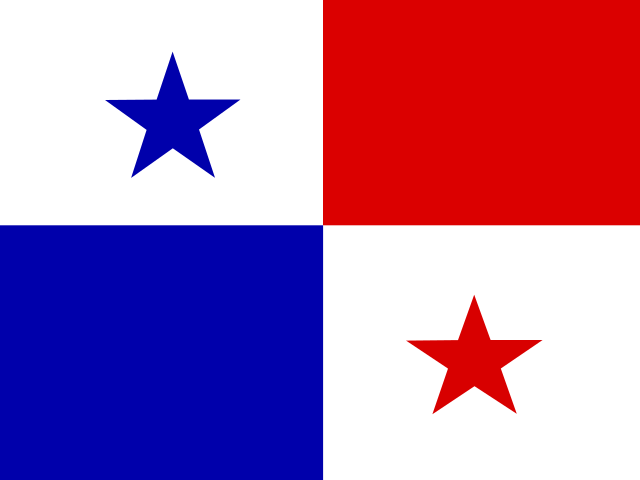
- Region
- Americas · Central America
- Capital
- Panama City
- Population
- 4,571,189 (2025)
- Government
- presidential republic
- Currencies
- Panamanian balboa (PAB), United States dollar (USD)
- Official languages
- Spanish
- Spoken languages
- Spanish (official), Indigenous languages (including Ngabere (Guaymi), Buglere, Kuna, Embera, Wounaan, Naso (Teribe), and Bri Bri)
- Written scripts
- Latin
- Area
- 75,417 km²
- Coastline
- Coastal
- UN member
- Yes
- Affiliations
- IMF, WCO, WTO
- Borders
- Colombia , Costa Rica
Political stability
70 / 100
Economic stability
49 / 100
Population stability
70 / 100
0–100, higher is more stable. Political: World Bank governance score. Economic: government effectiveness, regulatory quality, and inflation proximity to 2% (World Bank). Population: stability of growth and net migration rates (World Bank).
Trade profile
- Key exports
- copper ore, ships, refined petroleum, bananas, fish (2023)
- Key imports
- crude petroleum, ships, refined petroleum, nitrogen compounds, cars (2023)
- Natural resources
- copper, mahogany forests, shrimp, hydropower
- Luxury goods
- geisha specialty coffee
- Primary route
- The Panama Canal itself — interoceanic transit and transshipment (Balboa, Colón)
- Secondary route
- Feeder network across the Caribbean and Pacific coasts of the Americas
The xin.bz view
- The Panama Canal is the most visible direct connection between climate conditions and global shipping capacity: the 2026–27 El Niño is suppressing rainfall in the Chagres watershed, and the Canal Authority has begun reducing transit capacity.
- Panama constraints reprice cargo that never crosses the Canal — buyers displaced from Asian routings add demand to U.S. Gulf and Atlantic suppliers.
xin.bz coverage
El Niño 2026–27: Where Supply Falls, Where It Rises, and Which Corridors Carry It
The 2026–27 El Niño is on track to be one of the strongest on record. A quarter-by-quarter outlook of where supply falls, where it rises, and which trade corridors absorb the change.
El Niño's Caribbean Chain Reaction: Water Stress, Rice Stocks and Panama Limits Arrive Together
El Niño connects Caribbean water stress, falling U.S. rice stocks, a weak Indian monsoon, and Panama Canal limits into one food, freight, and stability risk through mid-2027.
El Niño's North American Reallocation: Food, Fuel, Freight and Trade Under Pressure
North America becomes the world's replacement supplier in the 2026–27 El Niño while wheat, rice, beef, water, and diesel stay tight and Panama pushes freight onto U.S. rail.
El Niño Is Reordering South America's Export Map
El Niño makes South America the world's replacement supplier — record Brazilian crops, Argentine rainfall gains, Peru's fishmeal shock, and the logistics that decide who can move it.
El Niño Is Splitting Africa's Water Map — Just as the World Turns to the Continent for Food, Fertilizer, Fuel and Critical Minerals
A wetter Horn and a drier south, Southern Africa's grain and Kariba buffers, cocoa's port squeeze, Moroccan phosphate and Nigerian fuel as global substitutes, and the corridors that turn African resources into accessible supply.
Vessel-Days Are Becoming the Scarce Asset in Global Shipping
The merchant fleet is growing while effective capacity tightens — Hormuz detours, Panama slot cuts, war-risk insurance, officer shortages and drydocking are consuming the ship-days that move cargo.
The Fuel Dock Becomes the Next Shipping Chokepoint
Large-vessel bunker constraints are moving from refinery systems into global freight economics — a 218,000 b/d fuel-oil deficit, 12–15-day Singapore lead times, and the routes, industries and carriers that pay first.
Commodity Deep Dive ·
LNG Is the Fuel That Freed Gas From the Pipeline — and Every Cargo Sails Past a Chokepoint Someone Can Close
LNG deep dive — 436.98 Mt of seaborne trade in 2025, the United States at 110.74 Mt, Qatar under force majeure since March 2026, JKM at $27.51/MMBtu, and roughly 80 Mt a year routed through the Strait of Hormuz.
Commodity Deep Dive ·
Wheat Is the Grain That Feeds a Fifth of Humanity's Calories — and a Quarter of Its Exports Leave Through One 700-Metre Channel
Wheat deep dive — 822.4 Mt of world production against 211.7 Mt of trade, China at 140.1 Mt, Russia exporting 43.0 Mt through the Turkish Straits, and CBOT nearby wheat at $7.26 a bushel.
Trade research
- WTO trade profile — tariffs, trade in goods and services, top partners
- World Bank country data — GDP, trade share of GDP, logistics indicators
- OEC trade profile — export/import composition and partners, visualized
- ITC Trade Map — detailed trade statistics by product (ITC/UN Comtrade)
- CIA World Factbook — geography, economy, transportation infrastructure
xin.bz can watch Panama for you — email alerts when new disruptions hit. Start free
Sources: mledoze/countries (ODbL), CIA World Factbook (public domain), World Bank Open Data (CC BY-4.0), flag-icons (MIT). Stability scores are xin.bz composites of the cited World Bank indicators; routes and commodity notes are xin.bz assessments. Informational only — verify with official sources.